February 3, 2026
Kirsten Quinn
What happens when marketing stops performing? A story about how to build brand credibility people trust.
For eight years, we did what good marketers are supposed to do.
We taught.
We wrote blog after blog sharing everything we knew—from how to feel comfortable in front of the camera, to what to wear for headshots, to how to think strategically about storytelling, video engagement, visual branding, and the psychology behind content that resonates. We broke down frameworks. We shared best practices. We made it our mission to give our community real, usable expertise.
And for a long time, it worked.
But slowly—almost imperceptibly—something shifted.
We were teaching, teaching, teaching… but not really connecting. Educating, without quite resonating.
It wasn’t that the content was wrong. It was solid. Thoughtful. Helpful.
But it started to feel like our audience was waiting for more—something they couldn’t quite name.
They understood our minds.
They didn’t yet understand our hearts.
Who we are. What we stand for. Why we care so damn much.
And if we’re being honest, we didn’t yet know how to show it—at least not in our marketing.
So we experimented.
We started telling more stories. Letting ourselves be a little more vulnerable. Talking about the struggles, not just the strategies. We added playful gifs to our newsletters and blogs—not because they were “on trend,” but because they spoke to the very human friction that gets in the way of implementing all that good advice.
Instead of always leading with tidy lists and perfectly packaged tips, sometimes we led with questions. With moments we didn’t yet have answers for. With experiences we all quietly share.
We pulled back the curtain more often than we stood behind the podium.
Around that time, Lindsay gave me (Kirsten) a task.
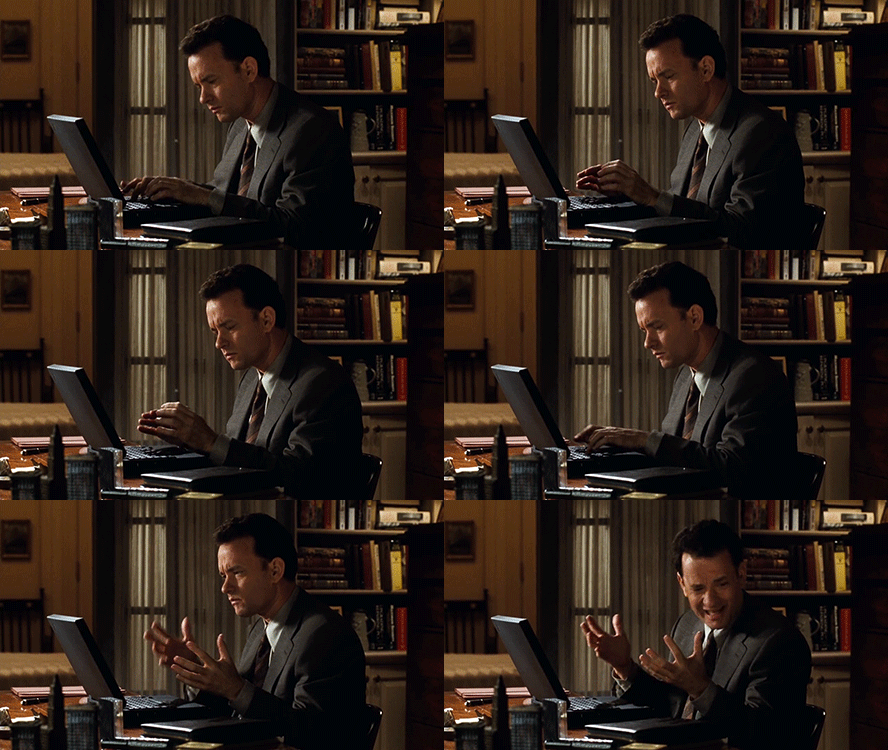
“Work from home for a few days,” she said.
“Play. Don’t polish it. Don’t strategize. Just write.
Love it. Hate it. Trash it. Yell at it. But rediscover what you have to say.”
It felt messy. Uncomfortable. Almost irresponsibly unproductive.
And it worked.
It gave me my conviction back. And it gave us our voice back.
More accurately, it helped us finally uncover the meaning beneath all those how-tos and best practices.
That day, writing from a desk littered with half-empty coffee cups and crumpled post-its, a realization surfaced that would reshape how we think about marketing:
“I’d gotten so wrapped up in my checklists and well-researched strategies that I’d forgotten the heart of marketing isn’t conversion. It’s connection.
And connection can’t be manufactured. It’s not found in a content formula or a three-step funnel. You have to live it. Feel it. Create from it.
And if marketing is meant to connect us, then how can we do it without putting ourselves on the page?
Maybe it’s not about reinventing our marketing.
Maybe it’s about remembering why we started creating in the first place.
Because at the end of the day, there’s no algorithm for true human connection.
There’s only the courage to create something real.And maybe—just maybe—that’s exactly what our audience has been waiting for.”
We’d been so focused on sharing our knowledge—on demonstrating our value—that we missed something essential.
There’s more than one kind of credibility.
And we’d been leading with only one.
We learned—through experience instead of theory—that credibility isn’t something you perform or perfect.
It’s something you introduce and then build, thoughtfully, over time.
How To Build Brand Credibility
We tend to talk about credibility as if it’s a single trait.
You’re credible.
You’ve established authority.
You’ve earned trust.
But credibility doesn’t land as a single experience.
It shows up differently depending on context. It feels different depending on timing. And it carries different weight depending on what someone needs in each conversation.
Often credibility feels like:
“This person knows what they’re talking about.”
Other times it feels like:
“This person understands me.”
And sometimes it’s even quieter:
“I trust people who trust them.”
“They’re consistent. Reliable. Grounded.”
None of these are better or worse. They’re simply different.
The mistake many brands make isn’t in lacking credibility—it’s in assuming that one should do all the work, in every situation, for every audience.
In reality, credibility is something you introduce over time.
It’s layered. Sequenced. Built through moments.
The most effective brands don’t just ask, “How do we prove our value?”
They ask, “What does our audience need to feel right now—and which kind of credibility supports that feeling?”
Once you start looking at credibility this way, a lot of things begin to make sense:
- Why some content feels impressive but distant
- Why expertise sometimes gets overlooked
- Why connection often opens doors that persuasion can’t
Through that lens, credibility stops being something you perform—and starts becoming something you share intentionally, at the right moment, to move trust forward.
And that’s where the different types of credibility come into play.
1. Earned Credibility
“You understand me.”
 Earned credibility is the kind you don’t announce—you feel it.
It’s the moment a reader pauses and thinks, Yes. That’s exactly it.
Not because you impressed them, but because you named something familiar.
This type of credibility is relational before it’s intellectual. It’s built when your audience feels seen—when your words reflect their lived experience, not just your expertise.
Earned credibility comes from:
- Lived experience (or real proximity to it)
- Self-awareness and humility
- Clear thinking without posturing
- Language that mirrors how your audience actually talks and thinks
It’s what allows someone to trust your perspective before they evaluate your ideas.
When earned credibility is present, your audience isn’t asking, “Is this person qualified?”
They’re asking, “How do they know this?”
And that’s a very different starting point.
How Earned Credibility Is Built
Earned credibility doesn’t come from saying the right things—it comes from saying the true things, even when they’re a little uncomfortable or unfinished.
It shows up when you:
- Name the tension before offering the solution
- Acknowledge the friction between knowing and doing
- Share perspective shaped by experience, not just outcome
- Resist the urge to tidy everything up into a takeaway
Earned credibility often lives in the moments where you admit:
- This is harder than it looks.
- We don’t have this perfectly figured out.
- Here’s what surprised us along the way.
That honesty doesn’t weaken your authority—it grounds it.
When Earned Credibility Matters Most
Earned credibility is especially powerful early in a relationship, when someone is still deciding whether to lean in.
It works best in:
- Social media thought leadership
- Blog posts and newsletters
- Cold or warming audiences
- The top of your pipeline
This is why brands that lead only with expertise can feel distant, even when they’re right. Without earned credibility, ideas may be respected—but they aren’t always received.
For many audiences—particularly in relationship-driven, professional services—earned credibility becomes the doorway through which all other credibility must pass.
People instinctively ask:
Do you get me?
Only after that question is answered do they fully open themselves to the next one.
2. Demonstrated Credibility
“You know what you’re talking about.”
 Demonstrated credibility is what most people think of when they think of authority.
It’s the proof. The thinking. The strategy behind the work.
This is where expertise becomes visible—not through volume or bravado, but through clarity. Through structure. Through the ability to make something complex feel understandable without oversimplification.
Demonstrated credibility comes from:
- Frameworks that organize messy realities
- Pattern recognition built over time
- Trend analysis grounded in context, not hype
- Strategic restraint—knowing what not to recommend
At its best, demonstrated credibility doesn’t overwhelm. It reassures.
It tells your audience:
There’s a way through this—and it’s been thought through carefully.
How Demonstrated Credibility Is Built
Demonstrated credibility isn’t about proving how much you know.
It’s about helping others think more clearly.
It shows up when you:
- Create frameworks that reduce confusion instead of adding to it
- Explain why something matters, not just that it exists
- Share your thinking process, not just your conclusions
- Offer perspective, not prescriptions
The most effective demonstrations of credibility often feel understated. They avoid sweeping claims. They don’t chase every trend. They show discernment.
Sometimes the strongest signal of demonstrated credibility is what you choose not to say.
When Demonstrated Credibility Matters Most
Demonstrated credibility becomes especially important once trust has begun to form.
It works best in:
- Educational content
- Workshops and presentations
- Strategy conversations
- Mid-pipeline nurturing
At this stage, your audience isn’t just deciding whether they relate to you—they’re deciding whether they can rely on your thinking.
This is where demonstrated credibility does its best work: not as a first impression, but as reinforcement.
A Critical Nuance
For many audiences—especially those in trust-based, professional services—demonstrated credibility often carries less weight until earned credibility is felt.
That doesn’t mean expertise isn’t valued. It means context matters.
People who’ve been burned by polished presentations, confident recommendations, or one-size-fits-all frameworks tend to listen differently. Consciously or not, they’re still asking:
Do you understand my reality?
When that question has already been answered, demonstrated credibility lands as insight instead of noise.
When it hasn’t, even the smartest ideas can feel abstract.
This is why sequencing matters.
Demonstrated credibility is powerful—but it’s most effective when it follows connection, not when it tries to replace it.
3. Borrowed Credibility
“People like me trust you.”
 Borrowed credibility comes from what others are willing to say on your behalf.
This type of credibility is social and relational. It signals safety through association. It answers the quiet, practical question many people are asking as they move closer to a decision:
Has this worked for someone like me?
Borrowed credibility shows up through:
- Testimonials and reviews
- Case studies and referrals
- Long-standing partnerships
- Community involvement and reputation
It’s often the most visible form of credibility—and the most misunderstood.
How Borrowed Credibility Is Built
Borrowed credibility isn’t about collecting praise. It’s about curating context.
It’s strongest when:
- The voice sounds human, not scripted
- The story reflects the audience’s reality
- The language mirrors how your clients actually speak
- The proof confirms something the audience already feels
The most effective testimonials don’t sell outcomes. They reflect experiences.
They don’t say, “This company is amazing.”
They say, “This is what it felt like to work with them.”
That distinction matters.
When Borrowed Credibility Works Best
Borrowed credibility is most effective when your audience already recognizes themselves in your brand voice, such as:
- Case studies
- Proposal and pitch support materials
- Later-stage pipeline conversations
- Re-engagement campaigns
At this stage, borrowed credibility acts as reinforcement. It reduces risk. It provides reassurance.
It’s the moment someone thinks:
If this worked for them, maybe it could work for us too.
Should You Ever Lead With Borrowed Credibility?
Sometimes—but carefully.
Leading with testimonials or social proof can work when:
- The audience already understands your context
- The brand story feels familiar
- The proof is highly specific and relatable
Without that foundation, borrowed credibility can feel impressive but distant—like applause from a room you’re not yet sure you belong in.
Borrowed credibility is powerful not because it persuades—but because it confirms.
When it’s introduced at the right moment, it strengthens trust.
When it’s introduced too early, it can simply pass by.
4. Operational Credibility
“You’re consistent. Reliable. Grounded.”
 Operational credibility rarely announces itself.
It’s felt over time, through demonstrated consistency rather than conversation, through follow-through rather than framing. It’s the credibility that doesn’t ask for attention—but earns it anyway.
This is the credibility that lives in the experience of working with you.
Operational credibility is built through:
- Consistency in how you show up
- Clarity in your process and communication
- Follow-through on commitments
- Respect for time, scope, and boundaries
It’s what allows trust to settle in—and stay.
How Operational Credibility Is Built
Operational credibility isn’t created by one big moment, but through many small ones.
It shows up when:
- What you promise aligns with how you work
- Your messaging matches your delivery
- Your systems support clarity instead of confusion
- Your brand feels steady, not reactive
This is where your value builds from a statement into behavior.
Where Operational Credibility Matters Most
Operational credibility becomes most visible after the decision has already been made.
It matters deeply in:
- Ongoing client relationships
- Retention and referrals
- Long-term brand reputation
- Community trust
While earned credibility opens the door and demonstrated credibility builds confidence, operational credibility is what allows trust to compound over time.
It’s why some brands don’t just win projects—they build relationships that last.
What This Changed for Us
Once we saw the different forms of credibility at play—in business and in life—we couldn’t unsee it.
So we leaned in.
We stopped trying to show everything we knew, all at once.
We stopped wasting so many post-it notes on drafts that sounded smart but felt empty.
We stopped polishing ideas into neat little arguments and tied-up in bows.
Not because checklists don’t matter. (We still love a good checklist.)
Because credibility isn’t something you stack up and show all at once.
It’s something you introduce with intention, in response to what the moment—and the relationship—actually calls for.
The question stopped being, “How do I prove my value?”
And it became, “What does this person need to feel right now in order to trust me?”
Now that question shows up in everything we do, from how we write to how we show up when someone says yes.
Sometimes the most effective move is to lead with perspective instead of proof.
Sometimes it’s to offer structure instead of certainty.
Sometimes it’s simply to be consistent, clear, and human over time.
None of those approaches are better than the others.
They’re just different cards—meant to be played at different moments.
When we started playing our cards thoughtfully, our marketing stopped feeling like such a performance and finally felt like play. Like a conversation worth having.
And people noticed.
Credibility is no longer something we feel the need to chase.
It’s become something we take pride in earning—one thoughtful moment at a time.
Marketing Strategy With SchlickArt
At SchlickArt, we believe the best marketing strategies start with real conversations, honest goals and a deep understanding of your unique business. That’s why our approach to strategy goes far beyond spreadsheets and surface-level planning. We take the time to get to know you—your story, your values and the vision driving your work—so we can craft a plan that not only performs but feels right every step of the way.
Whether you’re scaling your business, launching a new offer or simply ready to take the guesswork out of your content, our strategy services are designed to bring clarity, purpose and momentum to your marketing. From high-level consulting and quarterly planning sessions to detailed content calendars and brand messaging, we offer tailored support that meets you where you are—and grows with you.
If you’re looking for a strategic partner who listens closely, thinks creatively and plans intentionally, we’re here to help. Let’s map out a marketing strategy that reflects your goals, supports your team and tells your story with impact.
About SchlickArt
SchlickArt, a luxury visual marketing company based in Santa Clarita, started in March 2012 with the simple idea that empowerment creates a kind of authenticity that shines through every camera lens. Built on a philosophy–rather than a product, service or person–SchlickArt has rapidly evolved, meeting fractional CMO, business and strategy planning, professional portraiture, business photo and business video needs as diverse as the community we capture. It’s the desire to take care of you, the client, that drives us at SchlickArt.






Share
Recent Posts
 02.17.26
The Subtle Difference Between Reactive and Proactive Marketing
The difference between staying visible and driving growth is subtle. We’re breaking down reactive vs proactive marketing—and how to tell the difference. January always feels powerful. You sit down with your team. You map out goals. There’s a fresh notebook. A new planner. A clean content calendar. Revenue targets…- 02.10.26
When the Jack-of-All-Trades Marketer Needs a Team
What an SNL luge skit accidentally gets right about modern marketing—and the plight of the Jack-of-All-Trades Marketer A couple weeks ago, we were on the couch watching SNL when Jane Wickline’s Winter Olympics promo sketch nearly took us out—the kind of laugh where you instinctively set your wine down before… - 02.03.26
Play, Don’t Prove: How to Build Brand Credibility People Lean Into
What happens when marketing stops performing? A story about how to build brand credibility people trust. For eight years, we did what good marketers are supposed to do. We taught. We wrote blog after blog sharing everything we knew—from how to feel comfortable in front of the camera, to… - 01.20.26
Rebuilding LEGO: The Brand Strategy That Fueled a Remarkable Comeback
How did LEGO pull off its comeback? This case study breaks down the brand strategy that fueled its turnaround. It’s hard to imagine now, but in the early 2000s, LEGO was quietly unraveling. Not in a dramatic, headline-grabbing way. No single scandal. No sudden collapse. Just a slow, expensive… - 01.19.26
Why Marketing Plans Fail: When Opinions Outweigh Execution
Too often, here’s why marketing plans fail: opinions outweigh execution. Discover why marketing strategy execution breaks down—and how to finally turn ideas into results. Most people don’t speak up because they want to slow things down. They speak up because they care. Opinions usually come from experience, concern, or… - 01.12.26
Our Marketing Strategy Framework: The Invisible System Behind Marketing That Works
A thoughtful marketing strategy framework designed to help business owners move from overwhelm to clarity—by aligning marketing from the inside out. Most business owners don’t come to us saying, “I need a marketing strategy.” They come to us saying things like: “I’m posting consistently, but nothing’s sticking.” “We’re doing…